
Responsible Traveller's Guide #TourismeDurable #DéveloppementDurable #Madagascar #MyMadagascar #MahajangaMaVille
Responsible traveler's guide
Responsible traveler's guide – Against the sexual exploitation of children
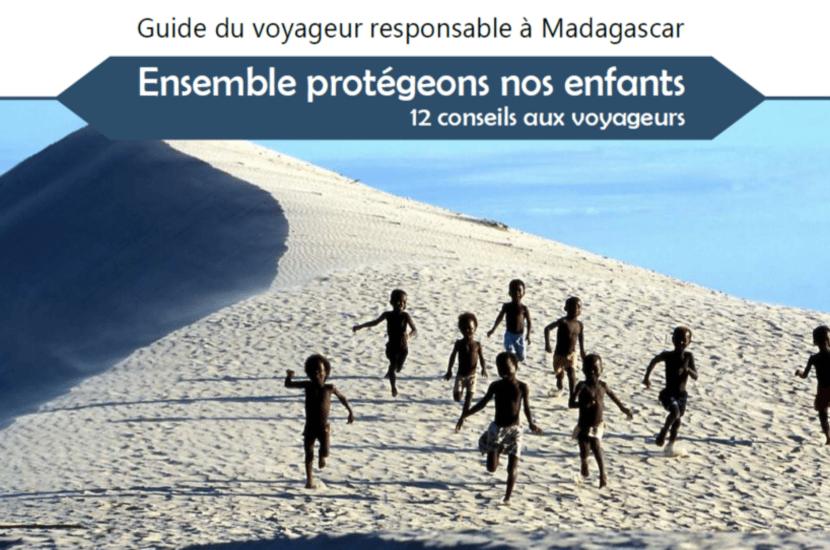
As part of the ESCALE project, “Preventing the Sexual Exploitation of Children in Tourism and Online Abuse” funded by AFD, the NGO ECPAT produced with the Ministry of Tourism the “ Responsible traveler's guide ».
This valuable and very useful guide is intended to raise awareness among travelers mainly on child protection issues.. Our establishment (Coco Lodge Majunga) has the honor to share it with you.
12 travel advice : Together let's protect our children
TIP #1 : Avoid distributing material goods directly to children.
If you would like to donate materials or clothing, give them directly to a local association, a list of which is available on the ECPAT France website.
Unsupervised distributions of toys, clothes, notebooks, pens or other things can cause children to quarrel, other requests and ultimately create dependencies and organized resale trafficking.
TIP #2 : Do not give money to children who beg
If you want to support these children, favor financial donations to local associations, a list of which is available on the ECPAT France website.
Some of the children who beg on the streets or at tourist sites are in the hands of exploitation networks that force them to beg.. By giving them money, you help make begging profitable, and therefore indirectly to develop these networks. Child protection associations are already working to take care of children in street situations and reintegrate them into their families or via reception centers.
TIP #3 : Do not photograph or film children without permission from a parent or guardian.
Generally speaking, avoid photographing or filming children from the front. Otherwise, make sure you get their consent, after having taken care to explain to them what you will do with the image.
Also try to ask permission from their parents if they are nearby.. In the event of publication or distribution of the image on the Internet, if the child is recognizable, you must have him sign an authorization (legal obligation). Never take photos of naked children.
TIP #4 : Check that child protection measures exist before visiting or volunteering in childcare settings.
Childcare facilities and orphanages are dedicated to protecting children and should not become tourist attractions. The influx of visitors to these centers can result in a “humanitarian business” opportunity with the risk of children being exploited for commercial purposes..
TIP #5 : Protect yourself before intervening with a child in immediate danger. Never act alone and report the matter to local authorities.
During your trip, you may come across children in the street, of abuse, domestic work or seeming abandoned. In case of immediate danger, contact a local child protection association or contact the office of the “fokontany” or “fokonolona” who represent the local authority in each neighborhood or village.
TIP #6 : Do not allow a child to accompany you alone and never take them away from their immediate environment.
Many children are often alone on the streets. Most are not orphans but live in nearby communities or on the streets with their parents or other groups of children.
Do not let them accompany or guide you and never take them away from their immediate environment..
TIP #7 : Do not pay children for services and choose structures that have adopted measures against child labor.
30% Malagasy children from 5 to 17 years are economically active. Child labor is a major obstacle to their schooling, their education and good physical and mental development.
Therefore, do not contribute to the employment or remuneration of children. And do not frequent places or establishments employing minor children.
TIP #8 : Do not expose yourself to the risk of theft, accident and be vigilant. Especially, do not expose a child to the temptation of stealing property from you.
Madagascar, 75% of the population lives below the poverty line, equivalent to €1.90 per day.
Some everyday consumer goods can be worth months or even years of wages. Be vigilant and do not expose your valuables.
On the other hand, driving in Madagascar can be dangerous. Then, please be careful.
TIP #9 : Never resort to prostitution of minors (- from 18 years)
This is a crime punishable by Malagasy law..
Sexual exploitation of children, especially girls, by tourists or travelers, is a reality in Madagascar.
The situation is increasingly alarming and the consequences for the development of children are dramatic.. This is a crime punishable by imprisonment under Malagasy law., whatever the age of the child and even if he or she appears to consent.
Age can be difficult to determine, especially among adolescents, but cannot under any circumstances justify the act. The perpetrators will be prosecuted on site by the Malagasy authorities., or upon their return to their country of origin.
TIP #10 : Report travelers using children for sexual purposes
If you have the slightest doubt about the behavior of a traveler who engages in “sex tourism” with a minor, report the facts via :
- the site www.reportchildsextourism.org
- the phone number 147 (Malagasy green line)
- the site www.arozaza.mg
You don't need proof or specific information about people. And can report a location, a detail about the behavior of the suspect or victim, even when you return from your trip. You can also contact the ECPAT office on site or the embassy of your country.
Signals, it’s about protecting children and fighting against impunity !
TIP #11 : Choose tourist structures that have adopted child protection policies and ethical leisure locations.
Madagascar promotes sustainable tourism that advocates solidarity, respect for the environment, sharing of wealth and respect for human rights and the rights of the child.
The country has developed a code of good practice signed by the Ministry of Tourism and tourism professionals wishing to combat the sexual exploitation of minors..
Use your purchasing power to influence tourism businesses to adopt respectful practices. Prefer structures that have adopted a child protection policy.
TIP #12 : Facilitate exchanges with children by learning a few Malagasy words.
Children and adults alike will always be happy to hear you speak their language ! It exists 18 dialects in Madagascar, spoken in different provinces. But certain words will be understood throughout the island :
Hello = Salama, Doing do, Hello
Goodbye = Veloma
MERCI = thank you
Mon nom est ... = my name is ...
Pardon, excuse me = Azafady
It sounded like day ! = have a good trip !
By l’Hôtel★★★ Restaurant gourmand #CocoLodgeMajunga
Reminder, we're both :
- one Hôtel★★★,
- one Gourmet restaurant,
- one 4x4 renter chauffeur guide
- one Event organizer (conferences, workshops, lunches/dinners with themes, wedding, Birthday...).
- and a Tour operator organising tours on And around Majunga and many others.