

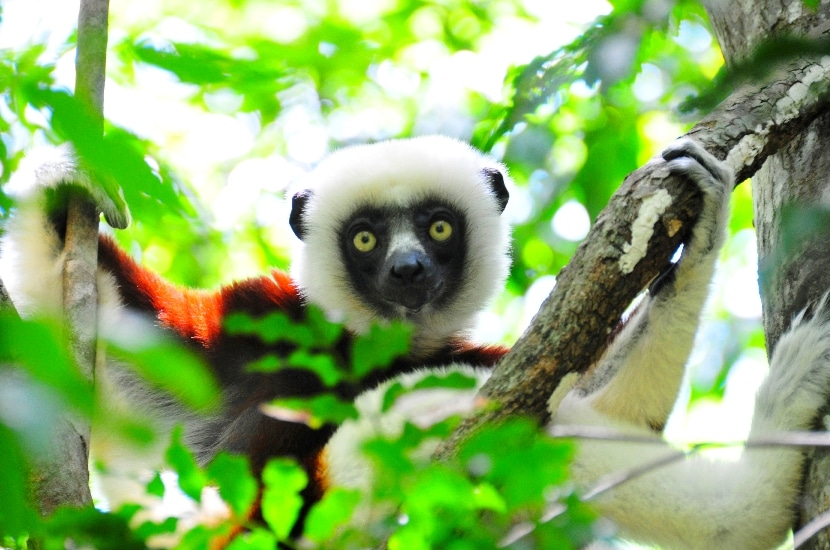
Biodiversity : What should we know about lemurs ?
Biodiversity : What should we know about lemurs ?
The NGO WWF Madagascar presents to us 05 things to know about lemurs, jewels of Madagascar’s biodiversity.
Where do they come from – ils ?
The ancestors of lemurs would have arrived from Africa to Madagascar by natural floating raft there are 65 million years. Then they evolved and adapted in the different types of existing ecosystems. Lemurs have therefore diversified and today occupy very specific areas where they are endemic..
Let's protect – the !
The arrival of the first human beings in Madagascar, two thousand years ago, marked the beginning of the exploitation of nature. Since, lemur habitat has shrunk due to deforestation, slash-and-burn cultivation, mining, illegal logging or charcoal mining.
Indeed, Madagascar lost 44 % of its natural forests for years 50. An update to the International Union for Conservation of Nature’s red list of threatened species (IUCN) reveals that 31 % all species of lemurs in Madagascar are now critically endangered. The population size of lemurs is also declining as they are hunted for their meat and to be domesticated as pets.
Our lemurs are also vulnerable to climate change.
Species can disappear and leave their original natural environment due to climate change. According to a scientific study published in 2019 In " Nature Climate Change », 95 % of lemur species habitat could be destroyed by 2070 because of global warming. En 2018, the report “Wildlife in a warming world” from WWF showed that the population of 57 lemur species will decline by 60% if the planet's temperature increases between 2°C and 4°C by 2100. In such case, three areas have been identified as climate shelters to lemurs : the Masoala peninsula, the Mangoky River and an area in the Northwest of the country, including the Ankarafantsika National Park.
Exploiting lemurs is punishable by law !
Detention, transport, the sale and consumption of lemurs is strictly prohibited by law. There are laws in force for the strict protection of lemurs as stipulated in the Protected Areas Code law. (COAP) or the International Trade in Endangered Species of Wild Fauna and Flora Act (CITES).
The decree 2006-400 classifies the wildlife species of Madagascar into three categories. Protected species in the category 1, including the lemur, benefit from absolute protection throughout the Malagasy territory. The hunt, the capture, detention, the consumption and marketing of species is strictly prohibited in all their forms.
Offenses are punishable by a sentence of six (06) months to twenty (20) years of imprisonment and/or a fine of 5.000.000 to 2.000.000.000 Ariary according to their severity.
What can we do for lemurs ?
Human commitment is very important for the conservation of lemurs. This is why the WWF, the administration and its partners are committed to the protection of lemurs and forests with local communities.
WWF also supports communities in restoring natural forests, which are the places where lemurs live, as well as in awareness-raising actions.
We can also join the global action allowing all citizens to sign an online petition “Our voices for the planet” to call on our leaders to commit to concrete actions to reverse the degradation of nature. Let's participate in the restoration of the habitats of these iconic species of Madagascar, who are the pride of our country. Let's get informed and make sure that lemurs are talked about around the world.
By #CocoLodgeMajunga
Hotel★★★ – Restaurant Gourmand – Pool bar – Event and conference organizer – Tour operator – 4x4 renter